EKJOT SINGH
Co-Founder & CTO @ RadonHarbor | Founder & Chief Scientist @ Metanthropic AI
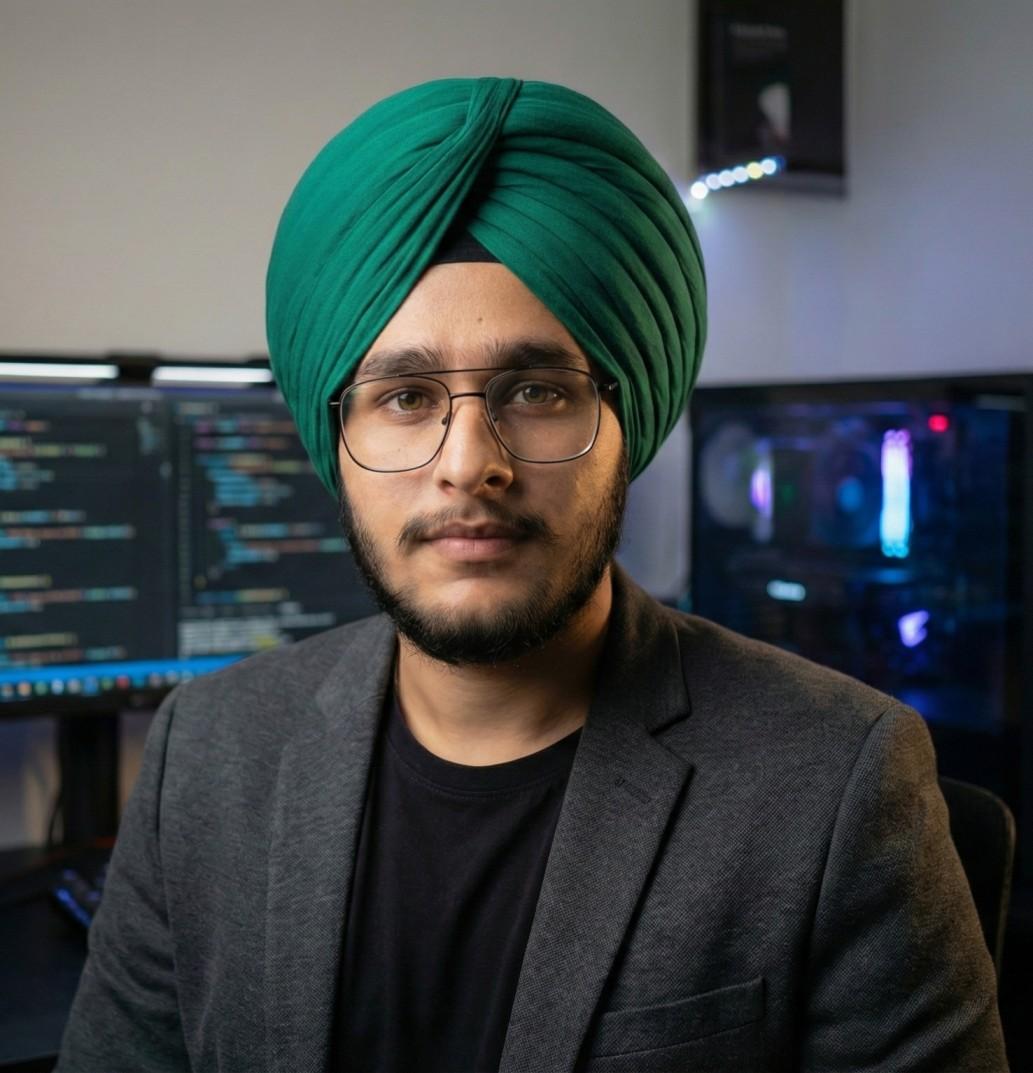
Ekjot Singh is an AI researcher and systems architect working at the intersection of foundational model pre-training, intrinsic AI safety, and high-performance distributed systems. He serves as the Co-Founder & Chief Technology Officer at RadonHarbor and the Founder & Chief Scientist at Metanthropic AI.
At Metanthropic AI, Ekjot directs an independent research lab focused on advancing model architectures and making AI systems inherently reliable, transparent, and safe by design. Rather than relying on post-training patches, his research integrates alignment and interpretability directly into the pre-training loop. Notable breakthroughs include Arvi 20B—a sparse Mixture-of-Experts (MoE) reasoning model engineered to deliver high-level reasoning capabilities at a fraction of standard computational costs—and MahenOCR, a 1B Vision-Language Model that achieved SOTA status on OCRBench and took #1 Place in the ICDAR 2025 DIMT Challenge for visual document understanding.
At RadonHarbor, Ekjot leads technical strategy and systems engineering to build infrastructure for autonomous AI execution. He architected AEGIS, a multi-agent operating system written in Rust and Python that utilizes secure WebAssembly (WASM) sandboxing to orchestrate complex, enterprise-grade workflows with zero-trust safety. His broader systems background includes designing Tealbase (an open-source backend platform built on Go and PostgreSQL) and ParachuteDB (a low-latency graph-vector database engineered for real-time AI retrieval).
Core Technical Focus & Research Vector
AI Research & Safety
Large-Scale Pre-Training, Sparse MoE Routing, Vision-Language Models (VLMs), Mechanistic Interpretability, Sparse Autoencoders (SAEs), Intrinsic Alignment (M-NAAR), RLVR.
Systems & Infrastructure
Autonomous Multi-Agent OS, WASM Sandboxing, Graph-Vector DBs, PostgreSQL Internals (RLS, CDC), Distributed Systems, High-Concurrency Architectures.
Languages & Core Stack
Rust, C/C++, Go, Python, TypeScript, PyTorch, ONNX Runtime, CUDA, vLLM, FlashAttention-3, Linux Systems Administration, x86 Assembly.
Experience
Experience & RolesCo-Founder & Chief Technology Officer (CTO)
Architected AEGIS, an autonomous multi-agent OS in Rust/Python with WASM sandboxing and high-concurrency orchestration primitives—achieving 95%+ task completion accuracy across enterprise workflows. Engineered zero-trust security layers and real-time telemetry pipelines to enforce sub-second multi-agent decision execution.
Key Scope & Research Deliverables:
- •Co-lead the company's technical vision, engineering strategy, and long-term research roadmap.
- •Lead research and development in autonomous AI systems, intelligent infrastructure, and next-generation software platforms.
- •Architect and build scalable, production-grade systems for developing, deploying, and optimizing advanced multi-agent technologies.
- •Translate cutting-edge research into production-ready solutions through rigorous experimentation, validation, and continuous optimization.
- •Establish engineering standards, software architecture, development workflows, and zero-trust technical best practices across the organization.
Founder & Chief Scientist
Founded an independent frontier research lab; pre-trained open-weight foundational models (Arvi 20B MoE) deployed and adopted by 1,000+ AI researchers and engineers. Pioneered intrinsic alignment & safety pipelines in PyTorch/C++ by integrating attention refraction (M-NAAR), interpretability, and deterministic unlearning protocols.
Key Scope & Research Deliverables:
- •Technical Leadership: Direct research spanning sparse MoE scaling, test-time reasoning, dataset distillation, and mechanistic interpretability.
- •Architecture & Pre-Training: Oversee end-to-end pre-training pipelines, ViT-LLM integrations, and RLVR frameworks.
- •Intrinsic Safety: Eliminate post-training patches by embedding safety, unlearning, and alignment directly into latent geometry.
- •Breakthroughs Delivered: Arvi-20B (Sparse MoE reasoning model matching gpt-oss-20b at <10x compute), MahenOCR (1B VLM #1 ICDAR 2025 DIMT & OCRBench SOTA), Chronometric Flux Gating (CFG for SAEs), and M-NAAR unlearning protocols.
Lead Systems Architect & Core Author
Architected Tealbase, an open-source Backend-as-a-Service (BaaS) platform built to eliminate the trade-off between rapid developer iteration and relational database rigor, empowering 10+ SMBs with sub-50ms WebSocket event propagation.
Key Scope & Research Deliverables:
- •High-Performance Platform Infrastructure: Architected the core backend engine from scratch in Go, engineering low-latency database proxying, dynamic connection pooling, and automated RESTful API generation mapped directly to PostgreSQL schemas.
- •Real-Time Engine & Change Data Capture (CDC): Built a high-concurrency real-time streaming pipeline leveraging PostgreSQL Logical Replication/CDC and WebSocket subscriptions to broadcast database state changes with sub-50ms latency.
- •Identity & Fine-Grained Security: Implemented an enterprise-grade authentication service featuring JWT management, OAuth integration, and direct binding to PostgreSQL Row-Level Security (RLS) policies for automated, zero-trust data access control.
- •Developer Tooling & Management APIs: Designed an intuitive CLI and admin management APIs to streamline local development workflows, automated schema migrations, and API key management.
Flagship Systems & Infrastructure
Databases, Engines & Developer PlatformsArchitected an open-source Postgres BaaS in Go with auto-generated REST APIs, native RLS, and a Change Data Capture (CDC) engine empowering 10+ SMBs with sub-50ms WebSocket event propagation.
Engineered an open-source OLTP graph-vector database in Rust, unifying high-dimensional vector similarity retrieval with graph traversal for ultra low-latency AI query execution.
Built an open-source cross-platform AI image upscaler for Linux, macOS, and Windows, optimizing neural super-resolution inference pipelines for hardware-accelerated local execution.
Research
Frontier AI & ResearchArvi 20B: Open-Weight Sparse MoE Reasoning Model
Pre-trained a 20B sparse MoE (3.6B active params/token) with native tool execution and CoT reasoning—achieving 10,000+ downloads and matching gpt-oss-20b performance at < 10× GPU compute. Engineered distributed training pipelines using PyTorch FSDP and FlashAttention-3; implemented 4-bit AWQ quantization to enable sub-50ms token generation on 16GB consumer GPUs.
MahenOCR: Soundness-Aware 1B Vision-Language Model
Engineered a 1B VLM using Identity-Dissonance Fine-Tuning (IDFT)—achieving SOTA on OCRBench (< 3B class), #2 Place in ICDAR 2025 DIMT Challenge, and 8,000+ downloads.
SPECIFICATION: Metanthropic Neural Ablation via Attention Refraction (M-NAAR)
Introduces M-NAAR to resolve the 'Unlearning Trilemma.' By refracting attention away from high-entropy tokens rather than destroying weights, we achieve 0.00 hallucination rates and robust deletion without lobotomizing the model.
Specification for Latent Logic Topology & Soundness-Aware Calibration
Operationalizes LLMs as engines of 'Latent Causal Chains' to solve the RLVR Convergence Paradox. Introduces the Soundness-Aware Level (SAL), a microscopic metric that predicts post-alignment reasoning performance with 87% accuracy.
Technology
Engineering CapabilitiesLanguages
AI Frameworks & Tooling
AI Research & Safety
Systems & Infrastructure
Background & Credentials
Academic Background & Stanford AccreditationsVellore Institute of Technology (VIT)
B.Tech. in Computer Science and Engineering
Core focus on Systems Engineering, Foundational AI Models, High-Concurrency Architectures, and Database Internals.
Blogs
Deep Dives & Personal ThoughtsSolving the Unlearning Trilemma with M-NAAR
Achieving 0.00 hallucination rates in model unlearning by refracting attention away from high-entropy tokens.
Latent Logic Topology & SAL Calibration
Operationalizing LLMs as engines of 'Latent Causal Chains' to solve the RLVR Convergence Paradox with 87% accuracy.
Chromabase: Filesystems into Pixels
A powerful Rust CLI utility for high-density cloud storage bypass via video archives.